

Julius Burger (Bürger)
By Dr. Ryan Hugh Ross, PhD
This biographic article details the extraordinary life and career of Viennese born émigré Julius Burger (Bürger). He was poised for a successful career as a classical composer having studied and apprenticed with some of the masters of the early 20th century. However, his life was forever altered by the Nazi Regime’s anti-Semitic ideology. Despite decades of struggle, he continued to compose in multiple genres for over 70 years – taking solace in the sound world he created. However, it wasn’t until he was in his twilight years that the aged composer was able to hear his works for the first time. Burger considered these works his children, having no offspring of his own. By sharing his story and performing his music, it is the hope that these “children” will finally step off the faded manuscript pages and into the world for all to enjoy.
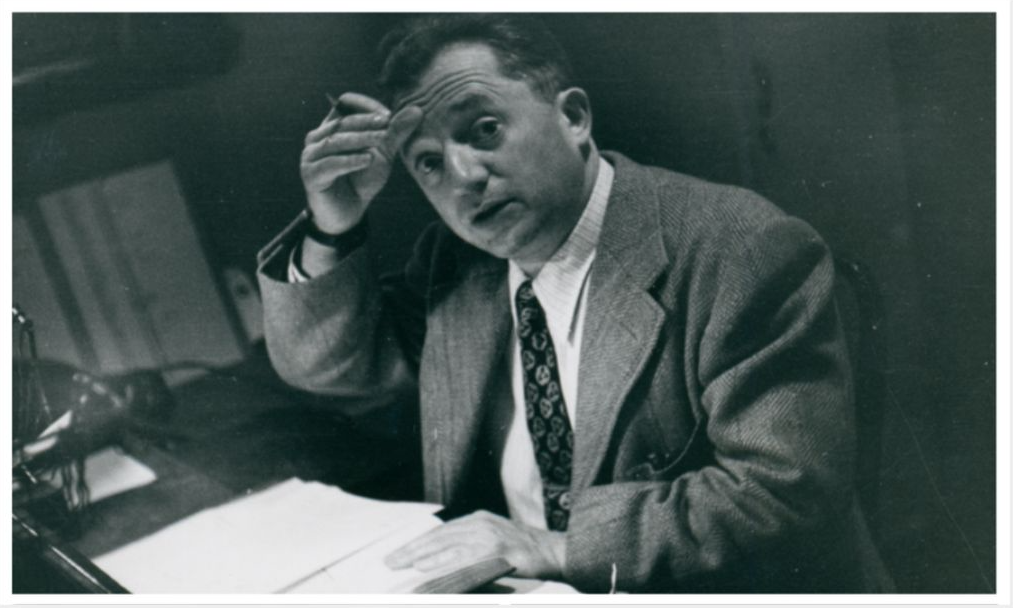
Julius Burger (Bürger) was born on 11 March 1897 in Vienna’s 2nd District of Leopoldstadt, the fifth child of nine to Josef Bürger – a tailor – and Chaje (Clara) Bürger – a homemaker. While little is known about Julius’ early life, he recollected in various interviews as having an enjoyable and “carefree” childhood in which his parents put a strong emphasis on education. Burger and his siblings were each afforded the opportunity to study.
As an adolescent, Burger was admitted to the Kaiserlich-Königliches Erzherzog-Rainer-Gymnasium between 1908 – 1913 and later continued his studies at the Kaiserlich-Königliches Maximilian-Gymnasium (Wasagymnasium) in Vienna’s 9th district until 1916. While still a student at the illustrious Gymnasium, Burger composed his first work – a lied setting of Heinrich Heine poem – Dämmernd liegt der Sommerabend (1915).
Although it was evident the young Burger had a fine singing voice (which he maintained throughout his life), he chose music composition as his career focus. In 1916 he entered formal study at the Faculty of Arts-University of Vienna where he attended lectures with renowned musicologists Dr Guido Adler (1855-1941) and Austrian (later British) composer and musicologist Egon Wellesz (1885-1974).
Between 1917 and 1919, he continued studies at the Akademie für Musik und darstellende Kunst, Wien (now Universität) where he undertook practical study in harmony, piano accompaniment and cello. Most notably, he began studies in counterpoint and composition with famed Austrian composer Franz Schreker (1878-1934). This important relationship defined the young composer’s compositional style and is readily apparent throughout his large oeuvre.
During this period, he was also employed in several side endeavours. Two notable engagements include serving as accompanist to Moravian tenor Leo Slezak (1873-1946) on concert tour as well as working as an accompanist in Vienna’s silent cinemas. These theatres employed musicians to create the soundtracks in real time and Burger’s exposure to these pastiche accompaniment practices may be one source of inspiration for his pioneering radio potpourri genre.
In mid 1919, Burger briefly left his studies in Vienna and enrolled at the Hochschule für Musik – Berlin in order to study with German composer Engelbert Humperdinck (1954-1921). However, in Spring of the following year, it was announced that Franz Schreker had been appointed director of the Berlin Musikhochschule. This prompted Burger to return to Vienna where he rejoined his former teacher’s studio and readied preparations for a more permanent move to Berlin in the Autumn. Numerous other Schreker students also followed to Berlin such as Alfred Freudenheim (1898-1941), Alois Hába (1893-1973), Jascha Horenstein (1898-1973), Ernst Krenek (1900-1991), Alois Melichar (1896-1976, Karol Rathaus (1895-1954) and Isaak Thaler (b.1902-?).
In 1922, after mastering skills in composition, conducting and accompaniment in Berlin, Burger was employed as a korrepetitor for the opera house in Karlsruhe until 1924. His abilities as a conductor were later recognised by conductor Bruno Walter (1876-1972) who recommended Burger undertake an apprenticeship at the Metropolitan Opera in New York City. In his recommendation to then conductor Artur Bodanzsky, Walter wrote : ”Herr Julius Buerger [sic] is an excellent musician – at home in opera and concert – a very good accompanist, brilliant coach for singers – and deserves every recommendation.”
Burger worked in this capacity for three seasons at the Metropolitan (1924-1927) in which he served as a repetiteur, coach and accompanist. While still engaged with the company, Burger’s accompanist skills were also put into practice when he was chosen to perform with acclaimed contralto Ernestine Schumann-Heink (1861-1936). This multi-stop tour took them along the California coast from Coronado Beach to San Francisco and was in benefit of disabled veterans.
At the conclusion of his apprenticeship in 1927, Burger returned to Berlin and gained employment at the Kroll Oper as assistant to resident conductor Otto Klemperer (1885-1973). Ever the entrepreneur, Burger also moonlighted in freelance capacity as an arranger and composer at the Berlin Funkstunde (Berlin Radio Hour). In 1930, he resigned from the Kroll Oper and transitioned to full time employment with the Funkstunde.
Here he had early compositional success in the form of a broadcast of his symphonic overture Ozeanfahrt, 1925 as well as two commercial successes with songs penned for his friend- Austro-Hungarian and Romanian tenor Joseph Schmidt (1904-1942). These titles included his Zigeunerlied (1930) or “Gypsy Song” and Launisches Glück (1932). The latter utilised thematic material from Johann Strauss II and was incorporated into a new production of the opera 1,001 Nacht. It also appeared in the 1933 German film ‘Ein Lied Geht um die Welt’ starring Schmidt.
Burger’s most successful compositions with the Funkstunde, and later with the BBC, were in a light entertainment genre he pioneered, called ‘Radio Potpourri’. One such example is Hallo London, Here’s Berlin (1932)- an hour long collage of light orchestral and vocal music from musical comedies and operas. This was presented as a simulcast from the Funkstunde’s Berlin studios in partnership with BBC London on 14 November 1932.
However, the political landscape of Germany was rapidly changing and in April 1933, Burger was forced to resign from his position at the Funkstunde following the Nazi Regime’s passage of the Enabling Act in March of 1933 (Ermächtigungsgesetz). With it, his life in Germany became untenable and he returned to Vienna.
After several months of unemployment, he was offered a contract to create a Radio Potpourri programme for the BBC’s newly created Variety Department – headed by British entertainer and playwright Eric Maschwitz (1901-1969). The department’s programming ranged from revue, concert and music hall performances to presentations of old time musicals, operetta and light opera. Burger’s previous work in similar content in Berlin and his proficiency in English made him a valuable contributor to the department’s programme line-up with his pioneering radio genre, Radio Potpourri.
These radio programmes are musical collages which use a collection of pieces or excerpt themes from pre-existing works and incorporate a storyline and narration on a given subject. They became popular mainstays at the corporation between 1934 into the 1950s. In total, Burger wrote at least thirteen of these hour long works, multiple Miniature Potpourri as well as numerous other arrangements and orchestrations. Many of these works were rebroadcast or revived later. He even had an original work broadcast on the airwaves, titled Suite of Five Little Pieces (from Vienna), which premiered on 14 December 1937. This is significant as few other works by émigrés were broadcast during this volatile period while Burger’s works were regularly performed even during the 2nd World War!
Despite career success, Julius and his wife Rosa lived a precarious existence between 1933 and 1939. Several appeals to gain permission to remain in the UK had been rejected and the couple were forced to move frequently between short let stays and hotels between Brussels and Vienna with increasingly lengthy periods in London and Paris. A survey of surviving correspondence from this period reveals at least thirty different addresses across six countries and two continents. In 1938, rumours of a plebiscite vote on Austrian annexation began circulating and the Burgers decided to return to Vienna to vote against the action. While at a scheduled stopover in France, Julius noticed a newspaper headline exclaiming “Austrian Chancellor meets Hitler”. The couple saw this as a bad omen, immediately fled the train and abandoned their plans to return to Vienna.
Upon returning to London, a further urgent appeal was made by the BBC administration to the British Home Office in support of Burger but this too was rejected. The composer instead chose to apply for asylum in the United States. This proved successful with an affidavit of support by American tenor Charles Kullman (1903-1983) and the Burgers left the United Kingdom aboard the SS Aquitania on 25 March 1939 for New York City.
The couple eventually settled into an apartment in the borough of Queens and within a few months, Burger found employment as a freelance arranger with Columbia Broadcasting System (CBS) in early 1940. The work included arranging for classical middlebrow stalwart conductors Andre Kostelanetz (1901-1980) and Arthur Fiedler (1894-1979). One successful original work which stems from this period is his Roumanian Fantasy (1942) which was later recorded by Kostelanetz for the Columbia Masterworks label.
Throughout the war years, Burger set upon the momentous task of financially aiding his family in Austria while also attempting to garner visa documentation for their safe passage to the United States. While he had success on behalf of his brother Dr Bernhard Bürger and two other siblings, Stefanie and Max, who emigrated to England and Palestine respectively, four of his brothers and his elderly mother, Chaje, were murdered in the Holocaust. A fifth brother’s fate still remains unknown. This tragic blow prompted Julius to dedicate the second ‘Adagio’ movement of his Concerto for Cello and Orchestra to his mother’s memory.
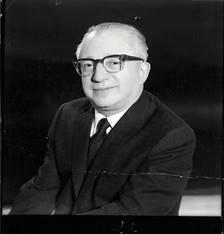
In 1944, the Burgers became US citizens (and dropped the umlaut from their surname) and over the next several years, Julius continued arranging for CBS while fulfilling commissions for the BBC. His final successful commission for the corporation – Victory Rhapsody (1945) was composed in anticipation of the Nazi Regime’s defeat. It was broadcast as part of the BBC Home Service’s Victory in Europe celebrations of that year.
In November 1944, Burger revived his conducting career, making his Broadway debut with the operetta Song of Norway. The fictional story centers on the young composer Edvard Grieg as he strives to create an authentic national sound for Norway. Only two years later, Burger was again engaged as a conductor, joining his old friend – tenor Charles Kullman – in a music album version of the Universal Pictures film Songs of Scheherazade.
In 1949, now in his early 50s, Burger returned to the staff of the Metropolitan Opera to serve as an assistant conductor and vocal coach. Here he was surrounded with a collegiate staff largely comprised of fellow émigrés including the house general manager Rudolf Bing (1902-1997), chorus master Kurt Adler (1907-1977), assistant chorus master Walter Taussig (1980-2003) assistant conductors Tibor Kozma (1909-1976), Renato Cellini (1912-1976), Pietro Cimara (1887-1967) and former Schreker student Martin Rich (1905-2000).
In his capacity as a repetiteur and coach, Burger worked with many well-known singers of the day. One notable singer was the African American contralto Marian Anderson (1897-1993) whom he coached for her 1955 debut in Verdi’s Un Ballo in Maschera. Burger also enjoyed a collegial friendship with American Bass Jerome Hines (1921-2003). The pair became well-known for their comedic concert antics as part of the MET’s post-performance receptions. Burger’s skills as an arranger and composer were also occasionally drawn upon at the company.
In 1954, Rudolf Bing commissioned Burger and ballet master Zachary Solov (1923-2004) to create a one-act ballet. The result was Vittorio. The piece featured thematic material from numerous Verdi operas for the score. Notably, this successful work’s premiere on 15 December 1954 marked conductor Dimitri Mitropoulos’s (1896-1960) debut with the company as well as his first engagement conducting a ballet. Another notable commission includes Burger’s orchestration and reworking of Offenbach’s La Périchole for a new 1956 production. This was directed by Cyril Ritchard (1898-1977) and enjoyed fifty-three performances between 1956 and 1971 as well as a commercial recording and an NBC live telecast.
Burger continued with the company for twenty years before retiring in 1969. His original manuscript scores from this period (1967 onward) reveal a burst of creative energy after having largely given up on original composing decades earlier. Burger’s “Early Period” (1915-1945) is defined by numerous large scale orchestral works and chamber compositions, radio programmes and some lieder. His post-1967 “Late Period” (1967-1988) largely contains chamber compositions, several string quartets, three works for choir and numerous song compositions. His passion for composing, despite decades of struggle, never diminished. The ruptures of 1933 and 1938 caused by the Nazi Regime meant he was not able to reach his full potential as a composer. As he entered the twilight years of his life, it became Burger’s mission to hear his compositions before he died.
One successful performance was at the New York Town Hall in October of 1952 when Latvian cellist Ingus Naruns (1925-2012) performed a reduced arrangement of the Concerto for Cello and Orchestra for two pianos with Burger and fellow pianist Antolijis Berzkalns. A second success came many years later when in 1984, aged 87, Burger’s orchestral work Variations on a Theme by Carl Phillipp Emanuel Bach (1945) won first prize at Indiana State University’s Contemporary Music Festival Competition. The work received its premiere on September 27th of that year in the university’s Tilson Music Hall.
Five years later, Burger’s personal life suffered a major blow when on 25 April 1989, Rosa (Blaustein) Burger died. The couple had been married over 55 years. Now in his early 90s, Burger contacted New York probate attorney Ronald S Pohl, Esq. to settle he and his wife’s estates. Through their conversations, Pohl was regaled with stories of Burger’s life and impressive career and equally, the composer’s desire to hear selections from his own large oeuvre before he died. The stacks of manuscript scores had now been sitting relatively untouched in the composer’s Queen apartment for years. Thanks to Pohl’s friendship and act of kindness towards the elderly composer, a revival of Burger’s music was initiated with a concert on 3 June 1991 in Alice Tully Hall in the Lincoln Centre, New York. Other orchestral concerts followed, including performances with the New Orchestra of Westchester in Purchase, NY, the University of Negev in Beersheba, Israel and the Austin Symphony in Texas.
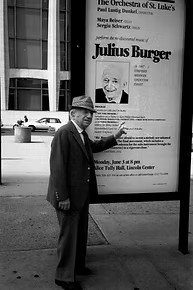
Despite ailing health, Burger flew to Berlin in September of 1994 where he attended recording sessions and a concert performance of his orchestral works in Berlin’s Jesus Christus Kirche. These were performed by the Rundfunk Sinfonieorchester Berlin with Australian conductor Simone Young at the helm. The following summer, having now heard many of his compositions performed, Julius Burger passed away in New York City on 12 June 1995. He was 98.
The Julius Burger estate, including his personal papers and manuscripts, was maintained by friend and attorney, Ronald S. Pohl, Esq. until 2016 when the collection was given on permanent loan to the Exilarte Zentrum Archiv der MDW in Vienna for preservation and research purposes. In 2019, nearly all of his Radio Potpourri works (totalling more than 5,000 autograph manuscript pages) were rediscovered in the BBC Sheet Music Library in Perivale, London- having previously thought lost to bombing campaigns of London or in subsequent reshuffles of the archival collections. These works have since joined the rest of Burger’s large compositional oeuvre spanning 73 years. Currently, the composer’s music is undergoing another large scale revival. August 2023 marked the spiritual return of Burger to his native Vienna with a live broadcast concert comprised of selections from his orchestral oeuvre by the ORF Radio Symphonieorchester Wien- RSO Wien – conducted by Maestro Gottfried Rabl.
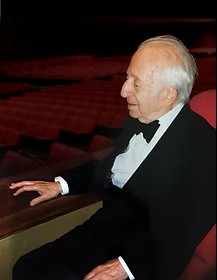
In addition, performances of his works are becoming more frequent and numerous publications are now available on this extraordinary figure. A recent agreement between the music publisher G. Schirmer, Inc. and the Exilarte Zentrum means many works from their ever-growing archive will soon be available to the public. To find out more about Julius Burger and the “Lost Generation’ of composers banned by the Nazi Regime, please see the following:
Additional Sources
BOOKS/ARTICLES:
Dr. Ryan Hugh Ross; Dr. Gerold Gruber (ed.): Julius Bürger: Composer-Conductor-Vocal Coach. in partnership with Exilarte Zentrum. (Vienna: Böhlau Verlag, April 2024).
https://www.vandenhoeck-ruprecht-verlage.com/detail/index/sArticle/59082
Dr. Michael Haas. Music of Exile: The Untold Story of the Composers who Fled Hitler (New Haven CT: Yale University Press, 2023).
https://yalebooks.co.uk/book/9780300266504/music-of-exile/
Ryan Hugh Ross. ‘Julius Burger’s Themes of London: An Émigré’s legacy at the BBC’ BBC History website, 7 December 2020.
https://www.bbc.co.uk/historyofthebbc/researchers/julius-burgers-themes-of-london
RECORDINGS:
(2023)- Julius Bürger. ORF Radio-Symphony Orchestra Vienna: Cello concerto | Songs for Orchestra | Eastern Symphony.
https://exilarte.org/en/projects-2
(2019)- A Journey in Exile – The Lieder of Julius Burger on Spätlese Musik Records™.
https://www.rediscoveredbeauty.org/burgerlieder-album
(2007)- Julius Burger: Orchestral Music on Toccata Classics label.
https://toccataclassics.com/product/burger-orchestral-music/
DOCUMENTARY FILMS:
Julius Bürger – expelled and rediscovered. A Viennese composer returns. Directed by Stephan Herzog, Herzog Media on behalf of the Exilarte Center of the University of Music and Performing Arts Vienna, 2024. Exilarte Zentrum website:
https://exilarte.org/en/dokumentaries
Julius Burger: A Journey in Exile. Directed by Margaret Constantas, Turtle Films in conjunction with Spätlese Musik Records, 2021. Rediscovered Beauty.org website:
https://www.rediscoveredbeauty.org/burger-film