

Aleksander Kulisiewicz
7 August 1918 – 12 March 1982
By Makana Eyre, Author of Sing, Memory
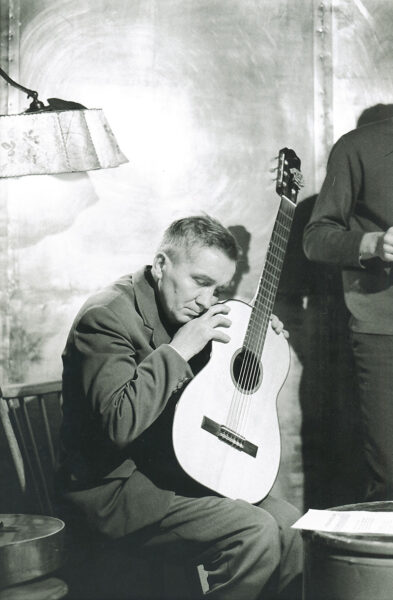
When the Germans invaded Poland in 1939, Aleksander Kulisiewicz was a stripling law student. While his father hoped he would become a lawyer and cement the Kulisiewicz family in Krakow’s elite, all Aleks cared to do was perform at cabarets and nightclubs where he sang, whistled and played his guitar, feeding off the energy of his audiences. War, however, put a swift end to his youthful, meandering life.
After writing articles critical of Hitler, Aleks was arrested by the Gestapo in the fall of 1939. The Gestapo eventually deported him to Sachsenhausen, a sprawling and sinister concentration camp just a short distance north of Berlin.
At Sachsenhausen, Aleks struck up an unlikely friendship with a prisoner named Rosebery d’Arguto (born Martin Rosenberg). Rosebery, Aleks soon discovered, had been a prominent conductor, composer and voice coach in Berlin in the 1930s before the Nazis arrested and deported him alongside thousands of other Jews living in the German capital. The friendship between Aleks and Rosebery grew deep when Aleks discovered that Rosebery had founded a clandestine Jewish choir at Sachsenhausen.
In early 1940, in barracks 39, Rosebery assembled some 25 prisoners, divided them into four parts, and began to build a men’s choir. The group gathered sporadically on weekday evenings when prisoners sometimes had a window of time to themselves. Other men in the barracks were astonished by the artistry it achieved, and Rosebery became a near mythical figure among the Jewish prisoners. When Aleks asked why Rosebery would take the immense personal risk of founding an illegal choir, he replied: “I could not look at the people here, knowing that they were to die without ever having sung together. It would be a betrayal.”
Aleks himself began composing song lyrics during the earliest days of his incarceration. His preferred compositions were what musicologists call parody songs, the term for when an existing melody is given new lyrics. In each of his musical creations, Aleks recounted the emotions he felt: his longings for home, his anger, the small yet significant triumphs of camp life, his hatred for the Nazis.
Aleks and Rosebery were far from the only musicians at Sachsenhausen. Over the course of the war, there existed German, Czech, and Polish choirs, some with just a few members, others counting several dozen. There were singing duets, a string quartet, a harmonica troupe, many informal groups, and countless individual performers. The German prisoner, Eberhard Schmidt, a friend of Aleks and Rosebery, played the cello in the string quartet. He remembered how the group obtained contraband scores by Beethoven, Brahms, Schumann, and Dvořák, which they rehearsed in the camp mortuary. The prisoner Bohdan Rossa was deeply moved by one of the quartet’s secret performances: “After the first few notes I thought I had a fever. It ran hot and cold down my back. It was like a dream.”
“Heil, Sachsenhausen!”, Aleksander Kulisiewicz. Photo courtesy of United States Holocaust Memorial Museum
Perhaps the most evocative of all the Sachsenhausen parody songs is Rosebery’s elegy for the Jews of Europe. Convinced the Nazis were exterminating Jews across the continent, Rosebery composed a set of lyrics in 1942 and set them to the melody of the Yiddish folk song, “Tsen Brider” (“Ten Brothers”). The original “Tsen Brider” tells the story of ten brothers who trade in geese, wood, cargo, and flax. One by one, as the song progresses, the brothers die. The chorus of d’Arguto’s adapted version, written in German so that everyone in the camp could understand it, goes like this: “Yidl with your fiddle / Moyshe with your bass / Play oh sing a little / We’re bound for the gas! For the gas! / For the gas!” The song ends with these words: “We never hurt another soul.”
Contrary to common belief, performances at the concentration camps were often semi-permitted, especially for groups of inmates with so-called privilege. The SS knew about and tolerated certain gatherings, as long as there was nothing political or subversive about them. Yet prisoners on the lowest rungs of Nazi ideology, and Jews in particular, had much less freedom to perform. At Sachsenhausen, Rosebery relied on the solidarity of German communist inmates who often had knowledge of when it was safest to gather. This information allowed the choir to perform for hundreds of mostly Jewish inmates in Sachsenhausen between 1940 and 1942. Yet in the end, the protection of the communists was not enough. In the fall of 1942, the SS burst into one of the choir’s rehearsals. After a night spent beating the singers, they deported most of them to Auschwitz in the weeks that followed. Aleks never saw Rosebery again.
After surviving the Sachsenhausen death march, Aleks returned to Krakow. Yet he was so tormented by his years of incarceration that he never managed to build a stable life. Instead, he spent most of his waking hours documenting the musical activities of prisoners of the Nazis and touring Europe and the United States to perform songs either he or other prisoners composed while in the camps.
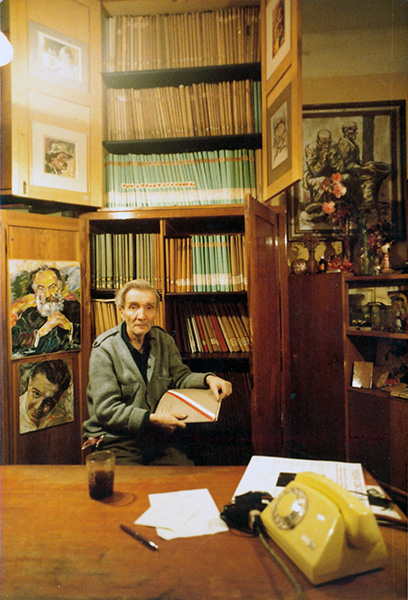
Over several decades, he amassed an enormous archive of interviews, testimonies, memoirs, scores, diaries, and letters from survivors of nearly every major camp in the German system. To him, the camp repertoire was essential historical witnessing. A lyric, crafted minutes or hours after a prisoner witnessed a hanging or felt delight over a German military defeat, would be a true testimony of the times. This was the invaluable evidence of an event or a thought or a feeling, small shards of a prisoner’s shattered life. Between the 1950s and early 1980s, he performed in at least 90 venues in 11 countries, including in New York City.
The enormous trove of documents he amassed over decades now makes up the Kulisiewicz Collection at the United States Holocaust Memorial Museum in Washington DC. Aleks died in 1982 at the young age of sixty-three. He is buried beside his mother in a Krakow cemetery. On his tombstone it reads: Bard of the camps.
Additional Sources
Makana Eyre: https://www.makanaeyre.com/