

Frederick Block
30 August 1899 – 1 June 1945
By Simon Wynberg, Artistic Director of the ARC Ensemble
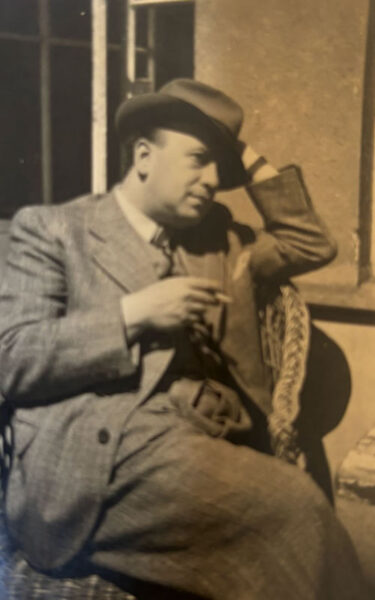
Frederick Block’s biography is possibly the most affecting of any of the musical exiles I have researched. A poignancy deepened by the solitude of his final years, and the almost total anonymity that followed his death. I first came across his name in the New York Performing Arts Library’s list of special collections. I had never heard of him, and neither had any of my colleagues. Block’s archive was left to the library in 2000, following the death of his wife Ina, and its content was impressive: half a dozen operas, symphonic works, piano solos, vocal cycles and a rich trove of chamber music. It seemed odd that history had comprehensively ignored a composer with so impressive a legacy and vita. A few weeks after my initial research online, I was sitting in the special collections room of the Performing Arts Library at Lincoln Center, working my way through the boxes of Block’s Archive.
As well as the composer’s beautifully penned scores, there was sufficient biographical information to chart the essential details of his life. He was born Friedrich Bloch in Vienna, on August 30, 1899, to a respectable upper-middle-class couple, Sigmund and Berta, who were Jewish, though not particularly observant. Sigmund’s successful wholesale business supplied flour to bakeries and animal feed to farms. Like so many fathers before and since, he supported music as a pastime, but doggedly opposed it as a career. He relented when Frederick, an only child, returned unscathed from the Italian front at the end of WWI, relief at his survival prompting a complete change of heart. Frederick’s first teacher was the esteemed Czech pedagogue and composer Josef Bohuslav Foerster. Later, at the University of Vienna, he studied with Hans Gàl.
By the 1920s, Frederick’s career was in the ascendant. On January 15, 1922 a concert of Frederick’s chamber music introduced him to Vienna’s musical establishment. There were many subsequent performances in both Vienna and Prague, notably a broadcast in March 1929, when his first Piano Trio, op. 15, shared a program with a Bartok string quartet. Sigmund had died the previous year and left the business to Frederick. The bequest, and the revenue it generated – Frederick was not involved in the management of business – meant that he could devote himself to composition. Concerts included the Vienna Symphony Orchestra’s premieres of an Allegro for Strings and his Notturni for voice and orchestra. During the early 1930s, several programs devoted to the younger generation of Austrian composers, included Frederick’s chamber music, but his focus soon shifted to opera, and between 1933 and 1937 he wrote no fewer than six (in addition to their libretti.) The third, Samum, based on a dark one-act drama by August Strindberg, was premiered at the Slovak National Theatre in 1936. The opera was widely and enthusiastically received, and Block’s scrapbook includes several pages of reviews. Frederick was on the brink of a substantial career, but the timing could scarcely have been less propitious. On March 12, 1938, Vienna awarded Hitler a euphoric welcome, and was soon supporting the full force of the race laws that had been incrementally imposed in Germany. By June, Frederick had abandoned his apartment at 25 Taborstrasse, and shipped his piano and personal effects to New York; the family business would doubtless have already been confiscated. He caught a train to Trieste, where he secured a British visa, made his way to Zurich, and then flew to London and his fiancée, Ina Margulies. They married soon afterwards and sailed to New York in the spring of 1940.
The Block’s apartment on Fort Washington Avenue, between West 177th and 178th street, gradually became something of a prison for Frederick. Recurring premonitions of his own death began to haunt him. Indeed, Frederick was so convinced by the legitimacy and inevitability of the portents, that he raced to set down as many new works as he was able to. There is nothing to suggest that he was suffering from an underlying physiological ailment. It is possible that the stress of his new life had caused this acute sense of foreboding, but I believe there is a less equivocal, more painful, more familiar reason for Frederick’s apprehension, and it is directly related to the circumstances of his flight from Vienna.
Frederick’s mother, Berta, a widow in her late-sixties, would have had required something close to a miracle to escape from Vienna and the Nazi occupation, and Frederick must have been acutely aware of her helplessness. He would have witnessed German barbarity at first hand, and read reports of the Kristallnacht, the death camps and, by 1943, the Nazis’ systematic effort to eradicate European Jewry. Like so many thousands of émigrés, his good fortune must have been accompanied by a large measure of guilt. The details of Berta’s fate were unknown to Frederick, but they are known to us now. Deported from Vienna to Prague and thence to the Terezin camp, she was among the 1,980 elderly and infirm Jews (Alterstransporte) who were packed onto the “Bq” transport on September 26, 1942 and taken to the Treblinka extermination camp.
By 1943, according to a friend, Frederick was “living the life of a houseplant,” seldom leaving his apartment. Late the following year he developed a chronic cough and early in 1945, the source of an intermittent, stinging stomach pain was diagnosed as cancer. Block died on June 1, just two months before his 46th birthday. The omens had finally made good on their threat. Anny remained in their Washington Heights apartment after Frederick’s death and survived him by 55 years. She never remarried. Anny and Frederick are buried next to each other in the Cedar Park Cemetery, Paramus, New Jersey – a very long way from Vienna.